New Forest Species Survival Fund - 2025 ecological survey results
Updated: May 5
Prof Russell Wynn (Wild New Forest)
1. Introduction
During 2024-25, the New Forest Species Survival Fund (SSF) project supported the delivery of conservation management action across 30 New Forest sites, including creation and restoration of grassland, heathland, wetland, and woodland habitats. This £1.3M project was co-ordinated by New Forest National Park Authority and supported by six partners including Wild New Forest, with match funding provided by the New Forest Biodiversity Forum. Further information about the SSF project can be found here.
My role in the project has been to deliver baseline ecological surveys at several sites to inform management actions, and to undertake return visits to sits where management actions had recently been delivered. An illustrated Wild New Forest blog summarising the 2024 ecological survey results is available here and an associated SSF news release was featured in various online media including BBC Countryfile here.
This update summarises the ecological results from both years, but with a focus on new data collected in 2025, particularly where they resulted from (or influenced) management actions delivered as part of the project. These management actions were co-ordinated by SSF partners including Amphibian and Reptile Conservation (ARC), Freshwater Habitats Trust (FHT), and Hampshire and Isle of Wight Wildlife Trust (HIWWT).
2. Methods
A total of 80 days was allocated to Wild New Forest for SSF ecological surveys in 2024-25, including all associated data analysis and dissemination. With 15 sites selected as survey priorities, careful planning was required to ensure that the surveys generated baseline data that would inform capital works and potentially allow future change to be monitored.
Walkover surveys were conducted at all 15 sites at appropriate seasons, with a focus on recording animals, plants, and fungi. Visual observations were supplemented by deployment of trail cameras, bat detectors, and sweep netting for invertebrates. A small number of fungus samples were retained for DNA analysis by Hampshire Fungus Recording Group, to support identification.
During the surveys there was a particular focus on ‘priority’ species of high conservation concern, i.e. species that are nationally red listed and/or nationally rare or scarce, based on the most recent assessments. All records of priority species were tagged with a location, and most records were supported by photo/video/acoustic evidence to aid independent verification.
3. Results
A total of 1160 species of animal, plant, and fungus was recorded over the two years of SSF survey, including over 200 records of 88 priority species. The results for different species groups are summarised below, together with details of any notable records.
3.1. Vertebrates - mammals
A total of 28 mammal species was recorded, including four priority species, aided by the deployment of up to 10 trail cameras and two bat detectors.
Pine Martens were regularly recorded at night on trail cameras at a site in the northern New Forest, with multiple sightings in both years and a pair scent marking on the same Rhododendron stump an hour apart on 01 Oct 2025. A nearby camera also recorded an unseasonal record of a female Pine Marten apparently transferring at least three kits between den sites on 15 Oct 2025, potentially indicative of local breeding. The latter observation influenced the approach taken by FHT and sub-contractors to Rhododendron removal at the site in Nov 2025, with a careful search conducted to ensure any possible den sites were avoided during the works.

Male Pine Marten on 01 Oct 2025 (all photos: Russell Wynn)
Other mammal highlights during walkover surveys included a rare sighting of a Water Shrew in the southern New Forest, seen visiting an apparent nest site multiple times on 03 July 2025, and three Brown Hares at a farmland site in the western New Forest. It was also encouraging to see Otters on trail cameras at two wetland sites in spring 2025 - this species is now widespread in most river catchments in the New Forest.

Brown Hare on 11 June 2025
Acoustic detectors were deployed at 11 SSF sites to capture baseline data on bats. A total of eight bat species was detected with high confidence, with just over 140,000 individual bat passes recorded over a total of 178 deployment nights. Barbastelle was recorded at all sites, with 418 passes recorded at one parkland site, while Serotine was recorded at all but one site; both species are nationally red-listed as Vulnerable but are widespread in the New Forest. Greater Horseshoe Bat was recorded at two sites in the Wiltshire sector of the New Forest, with two passes at one site and 35 passes at another site. These data are being shared with Hampshire Bat Group and Wiltshire Bat Group, and a news release summarising the bat survey results is available here.
3.2. Vertebrates - birds
A total of 97 bird species was recorded, including 13 priority species.
All the priority species are Schedule 1 and/or nationally rare breeding species that are known to occur in the New Forest, including Cetti’s Warbler, Crossbill, Dartford Warbler, Firecrest, Goshawk, Hawfinch, Hobby, Kingfisher, Lesser Spotted Woodpecker, Mediterranean Gull, Peregrine, Red Kite, and Woodlark. Identification of active territories of some of these species influenced the timing and scope of management actions to avoid disturbance.

Dartford Warbler on 11 June 2025
There were encouraging signs that wetland restoration work conducted at one site in autumn 2024 was already benefitting wetland birds the following winter and early spring. The work co-ordinated by HIWWT and FHT primarily involved removal of encroaching Grey Willow and Hemlock Water-dropwort, and topping of Soft Rush, from an area of botanically rich wet meadows bisected by ditches. Trail cameras deployed in the wetland in March 2025 recorded Grey Wagtail, Snipe, and Woodcock feeding on exposed mud, and a pair of Teal and a female Mallard with ducklings feeding in the restored ditch.

Restored damp meadow on 11 Mar 2025, where both Snipe and Woodcock were recorded feeding
3.3. Vertebrates - reptiles and amphibians
Seven species of reptile and amphibian were recorded, including three priority species.
Two Sand Lizards, nationally red-listed as Endangered, were seen at one site on 15 May 2025 where ARC had delivered initial management action in autumn 2024, providing encouraging signs that the species was starting to colonise from a nearby site on the open forest.
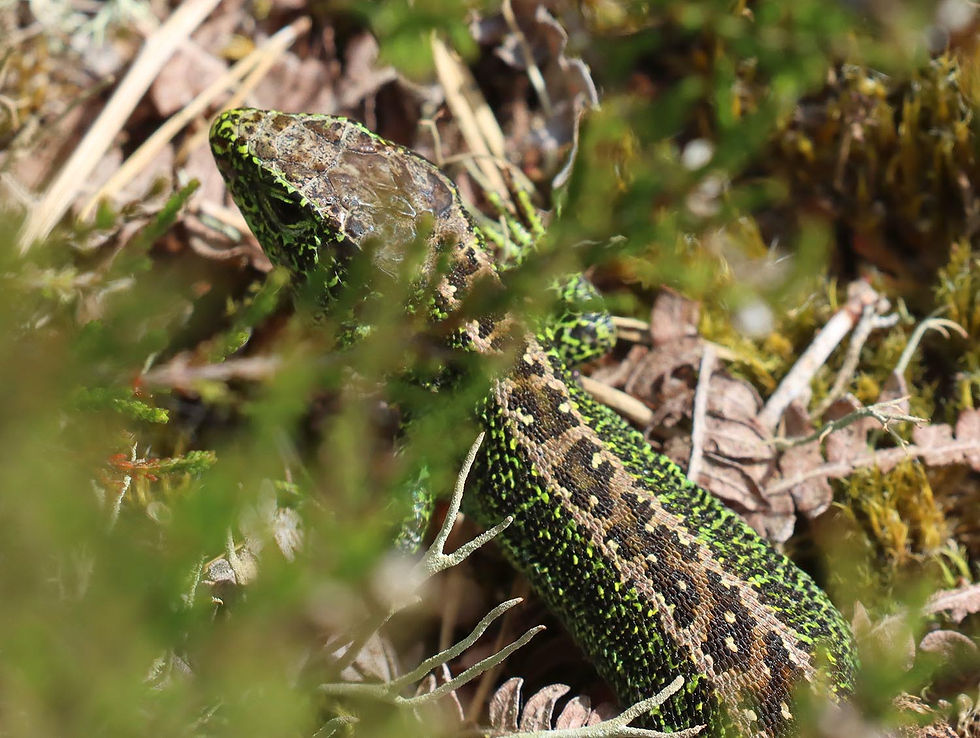
Male Sand Lizard on 15 May 2025
4. Invertebrates
A total of 431 invertebrate species was recorded, including 35 priority species.
A small colony of nationally rare 13-spot Ladybirds Hippodamia tredecimpunctata was discovered by sweep netting an area of rush pasture and damp grassland at a site in the northern New Forest in July-Aug 2025, which is the first New Forest record for over 15 years. The same site also held Bowed Jumping Spider Evarcha arcuata and several juvenile Raft Spiders Dolomedes fimbriatus, both of which are nationally scarce with a preference for damp habitats. It is anticipated that the installation of a series of small ponds at this site in autumn 2025, co-ordinated by FHT, will benefit these and other wetland species by increasing the diversity of wetland plants and the overall climate resilience of the damp habitats.

13-spot Ladybird on 10 Aug 2025
The nationally scarce but increasing Adonis Ladybird Hippodamia variegata was recorded at two dry grassland sites in the northwest New Forest, which were targets for wildflower meadow creation by HIWWT. This and the preceding species featured in a news release that also included the discovery of the first UK colonisation of ‘Little Arboreal Ladybird’ Calvia decemguttata in summer 2025 at several New Forest sites (outwith the SSF project). This news release featured in a variety of national and regional media, e.g. see here, and provided a good opportunity to publicise positive management actions that benefit ladybirds and other invertebrates.
A small colony of the nationally rare Pondweed Leafhopper Erotettix cyane was discovered on a man-made pond at a site in the northern New Forest on 06 June 2025, which is only the third time the species has been recorded in the New Forest. Removal of encroaching trees and scrub from the adjacent pond margins in 2024 will have benefitted this and other sun-loving species such as dragonflies and damselflies.

Pondweed Leafhopper on 06 June 2025
A walkover survey at a heathland site on 08 Aug 2025 focussed on areas where colleagues from ARC had undertaken some Gorse clearance to benefit reptiles such as Adders. There was a nice selection of nationally scarce invertebrate species that are dry heathland specialists, including the Ant Bug Alydus calcaratus and the Black Groundbug Megalonotus dilatatus, both of which will have benefitted from the recent works.

Matt Roseveare filming Ant Bug on recently cleared heathland on 08 Aug 2025

Adult Ant Bug on 08 Aug 2025
Two larval cases of the Large Heath Bagworm Pachythelia villosella, a nationally rare micro-moth, were found on Heather at a heathland site targeted for reptile habitat creation. It is only found in the UK on dry heathland in the New Forest and Dorset and is a proposed Red Data Book species - these appear to be the first site records. The larvae remain in a moveable case for two winters, and so a detailed search for larval cases was recommended to ARC colleagues prior to excavation of sand scrapes.

Large Heath Bagworm larval case on 15 May 2025
5. Plants
A total of 320 plant species was recorded, including 18 priority species.
The wetland restoration site referred to in Section 3.2 above is a Site of Importance for Nature Conservation (SINC) on account of its damp grassland assemblage. The removal of encroaching Hemlock Water-dropwort and exposure of areas of bare ground overseen by HIWWT and FHT in autumn 2024 saw a resurgence of wetland plants such as Ivy-leaved Crowfoot, Lesser Spearwort, and Marsh-marigold, with the latter being a rapidly declining species that is listed as Vulnerable in the updated national red list.

Ivy-leaved Crowfoot (foreground) and Marsh-marigold (background) on 27 Mar 2025
A series of grassland sites on relatively free-draining sandy soils in the northwest New Forest were surveyed in summer 2025, to assess recruitment of wildflower plugs/seeds planted by HIWWT as part of the SSF project. The exceptional drought conditions unsurprisingly hindered growth of all plants, but conspicuous species such as Common Knapweed, Cornflower, Oxeye Daisy, Ragged-robin, and Yellow-rattle were visible at several sites indicating successful recruitment. Thanks to diligent watering by the landowners, the newly-planted hedges at these sites seemed to be faring well during the drought.

Newly-planted hedgerow with protective fencing on 17 July 2025
6. Fungi
A total of 267 fungi species was recorded, including 15 priority species.
A remarkable suite of nationally rare/scarce fungi was recorded during baseline surveys of a small area of mixed woodland where FHT co-ordinated the delivery of Rhododendron clearance in Nov 2025. These included the Candelabra Coral Artomyces pyxidatus, one of six New Forest records in Sept-Oct 2025 that appear to represent local colonisation and that featured in national media (see here), and a specimen of Steccherinum bourdotii, which may also be a new arrival in the New Forest with the first four records in autumn 2025. Both species are nationally rare saprophytes (wood-rotters) of fallen hardwood. Other records included a cluster of nationally scarce Larch Spike Gomphidius maculatus(associated with Larch Bolete Suillus grevillei), the second Wiltshire record and the first New Forest record for over 20 years, and the nationally rare Ashen Woodwax Hygrophorus mesotephrus, found in autumn 2024 and confirmed by DNA analysis. All four species occurred in open woodland habitat immediately adjacent to the cleared area. The response of fungi to Rhododendron removal is not well understood, but clearing areas of dense understorey should enable more effective fungal spore dispersal and accretion, increasing the ability of fungi to colonise these areas.

Candelabra Coral on fallen Silver Birch branch on 23 Sept 2025
DNA analysis was used to identify a specimen of the uncommon Marsh Webcap Cortinarius uliginosus at a shady pond that was a potential FHT target for restoration - this species looks very similar to the Lakeside Webcap Cortinarius lacustris that was discovered at another SSF site last year, and that was confirmed through DNA as the first Hampshire and New Forest record.

Marsh Webcap on 11 June 2025
7. Future work
All records of priority species obtained in 2024-25 will be submitted to the appropriate recording schemes. Going forwards, I will be conducting three years of post-project monitoring at selected SSF sites starting in spring 2026, supported by match-funding from the New Forest Biodiversity Forum. This monitoring will document the ongoing colonisation of newly created and restored habitats by habitat specialists and priority species, and any change in the status of existing populations.
Acknowledgements
Many thanks to all project partners and landowners for facilitating site access and sharing data and expertise. The Species Survival Fund was developed by Defra and is being delivered by the National Lottery Heritage Fund in partnership with Natural England and the Environment Agency. Wild New Forest is a delivery partner of the New Forest SSF project, alongside New Forest National Park Authority as lead partner, and Amphibian and Reptile Conservation, Freshwater Habitats Trust, Hampshire and Isle of Wight Wildlife Trust, and the New Forest Commoners Defence Association. The New Forest Biodiversity Forum is providing SSF match funding to support three years of post-project ecological monitoring at selected sites.